Guide
Viking Oven Calibration: Test, Adjust or Repair
How to test a Viking oven with a thermometer, read its preheat light, set the temperature offset, and spot a failing sensor, igniter or bake element.
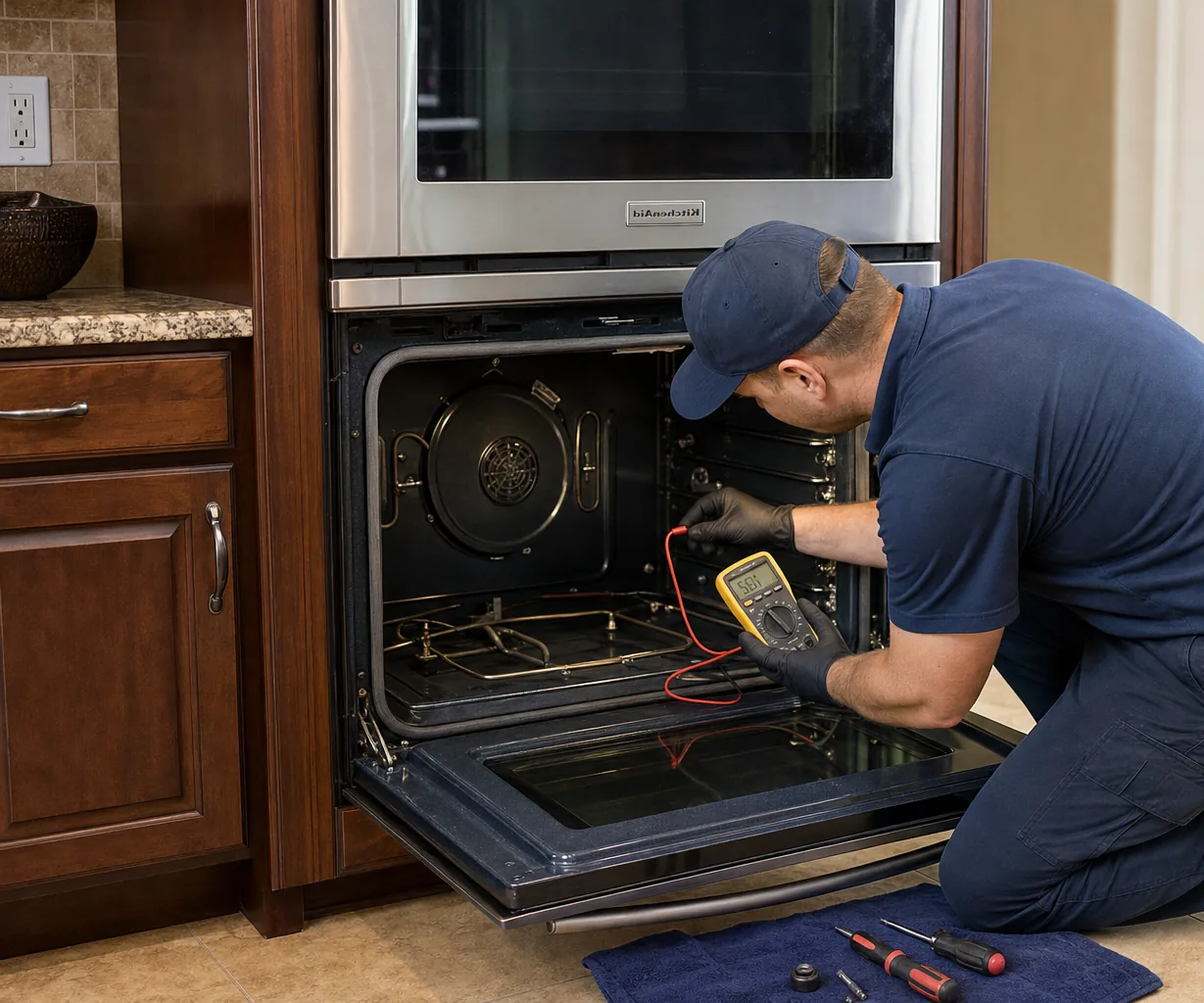
Viking oven calibration starts with a 30-minute thermometer test: preheat to 350°F, then average three readings taken 10 minutes apart from the center of the middle rack. If the average is within about 15°F of the setting the oven is fine, a steady error of 15 to 35°F can usually be corrected with an offset or thermostat adjustment, and a bigger gap, a slow preheat or an oven that never reaches temperature points to a failing sensor, igniter or bake element.
Most “my oven needs calibrating” calls come down to trusting the preheat signal too early, or a part wearing out. Here is how to tell which, on any Viking range or wall oven.
How do you know when a Viking oven is preheated?
On most Viking ranges and wall ovens, an oven indicator light comes on when you set a temperature and goes out when the oven first reaches it. Electronic-control models also sound a tone or change the display. After that, the light cycles on and off as the burner or element holds temperature. That is normal, not a fault.
The signal means the air near the sensor is hot, not that the heavy walls and racks have soaked up heat, so give the oven another 10 to 15 minutes before baking bread or pastry. Preheating a big Viking oven to 350°F commonly takes 15 to 25 minutes. If yours regularly takes much longer, or the light never goes out, treat it as a heating problem rather than a calibration question.
How do you test your Viking oven’s temperature at home?
You need an oven thermometer; a probe type with an outside display lets you read it without opening the door.
- Leave one rack in the middle position and remove any baking stone.
- Set the thermometer in the center of that rack.
- Set the oven to 350°F in standard Bake, not convection, and let it preheat fully.
- Wait another 20 minutes so the cavity settles.
- Take three readings, 10 minutes apart.
- Average them and compare the result with 350°F.
A single reading means little, because every oven cycles above and below its set point. Swings of 15 to 25°F either side are normal; the average is what counts. If you mostly roast, repeat the test at 425°F, since some ovens drift more at higher settings.
How do you adjust the temperature on a Viking oven?
Electronic controls. Many newer Viking ovens with a digital display have a temperature offset, sometimes labeled calibration, in the settings menu. If the oven averaged 330°F with the dial at 350°F, raise the offset by 20°F. The button sequence and maximum adjustment vary by series, so follow the use-and-care manual for your model.
Dial thermostat. Older Viking ranges with a mechanical oven knob use a capillary-tube thermostat. On many of them the knob pulls off to reveal a small calibration screw on the thermostat shaft, and a slight turn shifts the temperature a few degrees. Let the oven cool completely, make a small change and retest.
After any change, rerun the full test, and adjust in small amounts because overcorrecting is easy. One rule saves a lot of frustration: a steady error is a calibration issue, while an error that wanders, grows, or comes with slow preheating is a parts issue no offset will fix.
Why does a Viking oven run slow, uneven or off temperature?
| Symptom | Likely cause | What to check |
|---|---|---|
| Steady 15–35°F high or low | Control or thermostat drift | Thermometer test, then offset or adjustment |
| Temperature changes from day to day | Failing temperature sensor | Sensor resistance and wiring, tested by a technician |
| Gas oven slow to preheat; igniter glows but flame is late | Weak glow-bar igniter | Time from glow to flame; a healthy igniter usually lights the burner within about 90 seconds |
| Gas oven glows or clicks but never lights | Igniter too weak to open the gas valve | Stop retrying and call for service |
| Electric oven browns on top, pale underneath | Burned-out bake element | A break, blister or dark spot on a visible element |
| Uneven browning in convection modes | Convection fan or rear element | Listen for the fan; feel for heat from the back wall |
| Error code or blank display | Sensor circuit or control board | Note the code before you call |
Electronic Viking ovens read temperature through a resistance sensor inside the cavity. As it ages its reading drifts, and the control holds the wrong temperature with full confidence. A technician checks its resistance against the specification and inspects the wiring, because a cracked connector causes the same symptom.
On gas models, the glow-bar igniter both heats up and carries the current that opens the gas safety valve. As it weakens it still glows, but opens the valve later, so the oven preheats and recovers slowly. That looks like a calibration problem, but no adjustment fixes it. On a dual fuel range the oven is electric, so the checks are elements and the sensor, not an igniter.
When should you call for repair instead of recalibrating?
- The average is off by more than about 35°F, or an adjustment does not hold.
- Preheating takes well beyond 25 minutes, or the light never goes out.
- A gas oven is slow to light, lights with a loud whoosh, or does not light.
- An element is visibly damaged, or the display shows an error code.
If you smell gas, turn the oven off, leave the house and call your gas utility from outside.
Typical ranges: a diagnostic visit runs $95–$149, credited toward the repair. Replacing an oven igniter or bake element typically falls in the $250–$500 range, and most other range and oven repairs typically run $250–$900. The firm price is given on site after diagnosis; see oven repair for what a visit includes.
New Canaan homes run from older colonials to the mid-century modern houses the town is known for, and in both a pro-style range or wall oven is often built tight into custom cabinetry. Clear the floor in front of the appliance before the visit so the technician can slide the range out or open the trim.
New Canaan Viking Appliance Repair is an independent service, not manufacturer-authorized, covering New Canaan, Silvermine, Talmadge Hill, Darien, Wilton and Norwalk. Call (475) 472-9274 to book a diagnosis.
Frequently asked questions
How often should a Viking oven be calibrated?
Only when a thermometer test shows a steady error; there is no fixed schedule. A quick test once a year, or whenever recipes come out under- or overdone, is a sensible habit.
Should I test in convection mode?
No, test in standard Bake. Some ovens automatically lower the set temperature in convection modes, which makes readings hard to compare with the dial.
Why does my Viking oven light keep turning on and off?
That is normal cycling. Once the oven reaches temperature, the burner or element switches on and off to hold it, and the light follows.
Is it safe to calibrate the oven myself?
A menu offset or a small thermostat adjustment on a cool oven is a reasonable owner task. Testing sensors, igniters, elements and gas valves involves live voltage and gas, so leave those to a technician.